
For years, insurers have handled Scope 3 reporting the same way most large organizations have: report the categories that are easiest to measure, fill the remaining gaps with spend-based estimates, and treat claims-related emissions as too fragmented to track accurately.
The proposed 2026 Phase 1 updates to the GHG Protocol change that approach significantly.
Under the draft guidance, organizations seeking conformance would need to account for at least 95% of relevant Scope 3 emissions. Companies would also need to separate primary data from secondary estimates and disclose how emissions data was calculated and verified.
For insurers, this goes well beyond ESG reporting.
It affects procurement, vendor oversight, contractor relationships, and how claims supply chains are measured. Claims operations involve thousands of suppliers, materials, equipment vendors, waste haulers, and subcontractors. Historically, much of that activity has been estimated using industry averages or financial proxies.
The new direction from the GHG Protocol suggests those approaches may no longer be enough.
In Canada alone, claims-related spending represents tens of billions of dollars annually. As reporting expectations tighten, insurers that already invested in activity-based data collection and supplier-level visibility will be in a much stronger position than organizations still relying primarily on spend-based models.
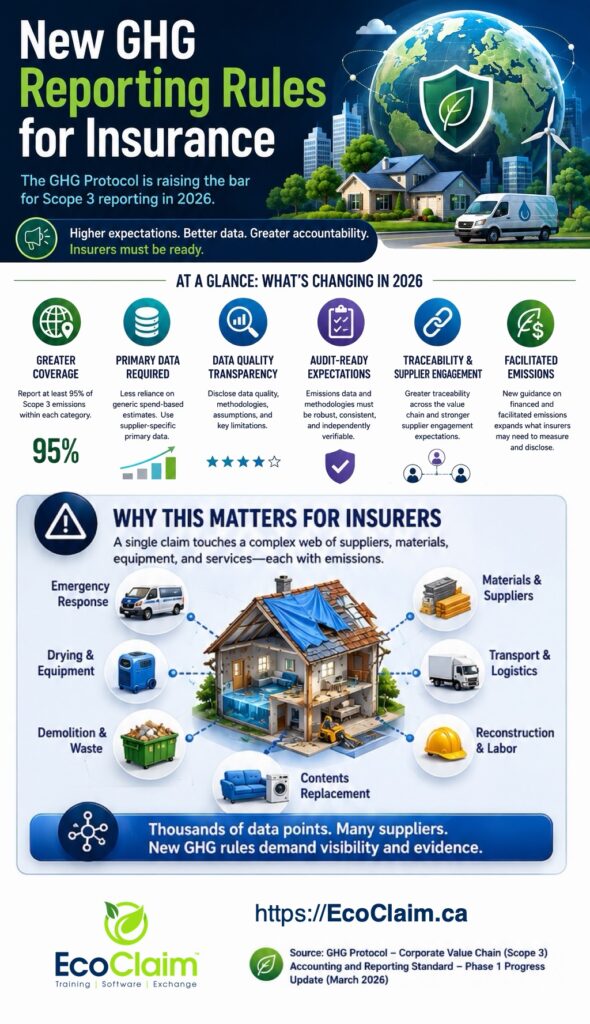
Several proposed changes stand out for insurers:
• The proposed 95% coverage threshold reduces the ability to selectively report only the easiest categories.
• Companies would need to clearly distinguish primary supplier data from secondary estimates.
• Facilitated emissions, including insurance underwriting activities, are receiving greater attention.
• Verification status would need to be disclosed, including whether emissions data is fully verified, partially verified, or unverified.
Together, these changes push organizations toward more traceable and defensible emissions inventories.
Claims supply chains are highly fragmented.
A single property claim may involve:
• Restoration contractors
• Materials suppliers
• Equipment rentals
• Waste disposal providers
• Logistics companies
• Subcontracted labor
• Contents replacement vendors
Most claims-related emissions sit within Category 1, Purchased Goods and Services, which is already one of the hardest Scope 3 categories to measure accurately.
Many insurers still depend heavily on spend-based methodologies. Under PCAF scoring frameworks, those estimates often receive lower data quality scores compared to activity-based or supplier-specific data.
Without claim-level measurement, emissions tied to demolition, material replacement, transportation, drying equipment, and waste handling often remain invisible within the final inventory.
For insurers, primary data may include:
• Material-level emissions tied to actual repair and replacement activity
• Waste diversion tracked by claim and disposal stream
• Contractor activity connected to specific jobs rather than annual supplier averages
• Equipment runtime and energy usage during mitigation and drying
• Transportation distances and logistics activity
• Supplier-specific emissions factors and EPD-linked materials data
The closer emissions tracking gets to actual operational activity, the more defensible the reporting becomes during audit and verification.
Many sustainability and procurement teams are already moving toward supplier-level accountability.
At the same time, frameworks such as:
• IFRS S2
• OSFI B-15
• CSRD
• PCAF
• CBAM
are all increasing pressure for granular, verifiable emissions data.
Organizations that began building supplier and claims-level measurement capabilities early are already seeing benefits:
• Better data quality scores
• Lower reporting friction
• Improved supplier engagement
• More credible disclosure processes
The larger challenge now is timing.
Building reliable claims emissions infrastructure takes time, especially across large contractor and supplier networks. The insurers that wait until disclosure requirements harden may find themselves trying to retrofit operational systems under regulatory pressure.
The proposed 95% threshold is not just a reporting adjustment. It signals a broader shift toward operationally verified Scope 3 reporting.
For insurers, that means treating the claims supply chain as a measurable system, not simply a downstream expense category.
The question is no longer whether more detailed Scope 3 data will be expected. The question is whether insurers have the systems in place to capture it accurately when reporting standards tighten further.
EcoClaim TRAX™ was designed to support this transition by helping insurers connect claim activity, supplier data, materials, waste streams, and operational emissions into a more auditable reporting framework.
Learn more: https://ecoclaim.ca/trax